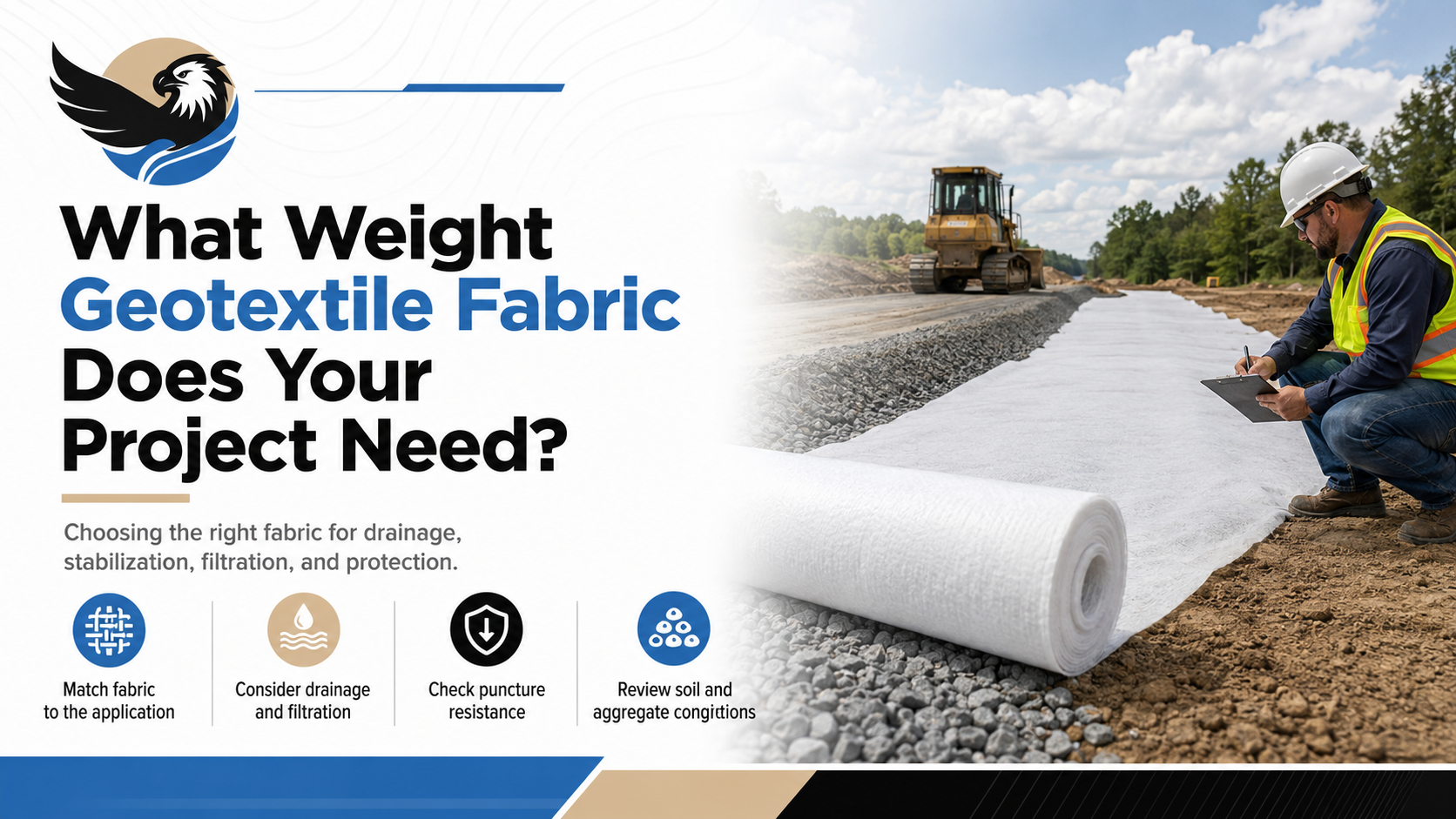
What Weight Geotextile Fabric Does Your Project Need?
Choosing geotextile fabric by appearance is a risky shortcut. Two rolls may look almost identical, yet one may be intended for light landscape separation while the other is designed to protect a liner beneath heavy stone. Contractors often ask what weight geotextie fabric they need, but weight is only the starting point.
Geotextile weight is normally expressed in ounces per square yard. With nonwoven fabrics, a heavier product is usually thicker and offers greater puncture resistance and cushioning. That does not mean the heaviest roll is automatically the best choice. Water flow, soil type, aggregate size, loading, and the purpose of the fabric all matter.
Start With The Job The Fabric Must Perform
Before comparing weights, decide what the geotextile needs to do. Separation keeps native soil from mixing with imported aggregate. Filtration lets water pass while holding soil particles in place. Drainage moves water through or along the fabric. Protection cushions a pond liner or geomembrane against sharp material.
A road base and a French drain may both use geotextile, but they place very different demands on it. Buying by weight alone can leave a project with poor drainage, inadequate strength, or unnecessary material cost.
Lightweight Fabric For Less Demanding Applications
Lightweight nonwoven fabrics, often around three to four ounces per square yard, are commonly considered for landscape separation, weed control, light drainage, and projects where the fabric will not face heavy loading or large angular stone.
They are easier to handle and may allow water to move readily through the system. Their limitation is durability under demanding placement conditions. A light fabric can be damaged when rough aggregate is dumped directly onto it, when the subgrade contains sharp rock, or when equipment travels over a thin cover layer.
Medium Weight Fabric Adds Protection
Nonwoven fabrics in the six to eight ounce range are often considered where filtration must be combined with better puncture resistance. Possible applications include drainage trenches, riprap underlayment, erosion control work, and protection around moderate aggregate.
This range can provide a useful balance between water movement and physical protection, but the correct product still depends on the manufacturer’s published properties. Two eight ounce fabrics are not necessarily identical. Compare permeability, apparent opening size, grab tensile strength, puncture resistance, and elongation before treating them as substitutes.
Heavy Fabric Is Intended For Tougher Conditions
Heavier nonwoven geotextiles may be selected beneath large riprap, over rough prepared surfaces, or as cushioning around geomembranes and pond liners. Extra thickness can help distribute contact pressure and reduce the chance that angular material will damage the layer below.
More weight can also change hydraulic performance. A heavier fabric should not be specified merely because it feels safer. Filtration design must still account for the soil being retained and the amount of water that needs to pass through the system.
Woven Fabric Requires A Different Comparison
Woven geotextiles are often chosen for separation and stabilization under roads, parking areas, construction entrances, and aggregate working surfaces. These products may be discussed by weight, but tensile properties and the ability to maintain separation under load are usually more useful selection measures.
For a weak subgrade, the important question may be whether the fabric can keep aggregate from disappearing into the soil while resisting installation damage. In some designs, geogrid is added for reinforcement. In others, a woven geotextile handles the required separation and stabilization by itself.
Check The Specification Before Ordering
Review the plans, approved product list, and required test values before selecting a roll. Confirm the fabric type, roll dimensions, expected overlaps, aggregate placement method, and whether equipment can travel directly over the installed material. An engineer’s specification should always take priority over a general weight recommendation.
Get The Right Geotextile For Your Arizona Project
Eagle Environmental Products supplies woven, nonwoven, monofilament, drainage, stabilization, and protective geotextiles for projects throughout Arizona. Call 480-833-2816 to discuss the soil conditions, aggregate, drainage needs, and project specifications so your team can order material suited to the work rather than relying on weight alone.
Live References
Eagle Environmental Products: Geotextiles
https://www.eagleenv.com/geotextiles.htm
Federal Highway Administration: Geosynthetics In Pavement Drainage And Stabilization
https://www.fhwa.dot.gov/engineering/geotech/pubs/05037/07d.cfm
US Fabrics: Geotextile Products And Selection Information
https://www.usfabricsinc.com/products/geotextiles/
E.J. Prescott: Selecting The Correct Geotextile Fabric
https://www.ejprescott.com/blog/the-importance-of-selecting-and-using-the-correct-geotextile-fabric
Vodaland: Geotextile Fabric Weights And Applications
