Geogrid Vs Geocell For Soil Stabilization
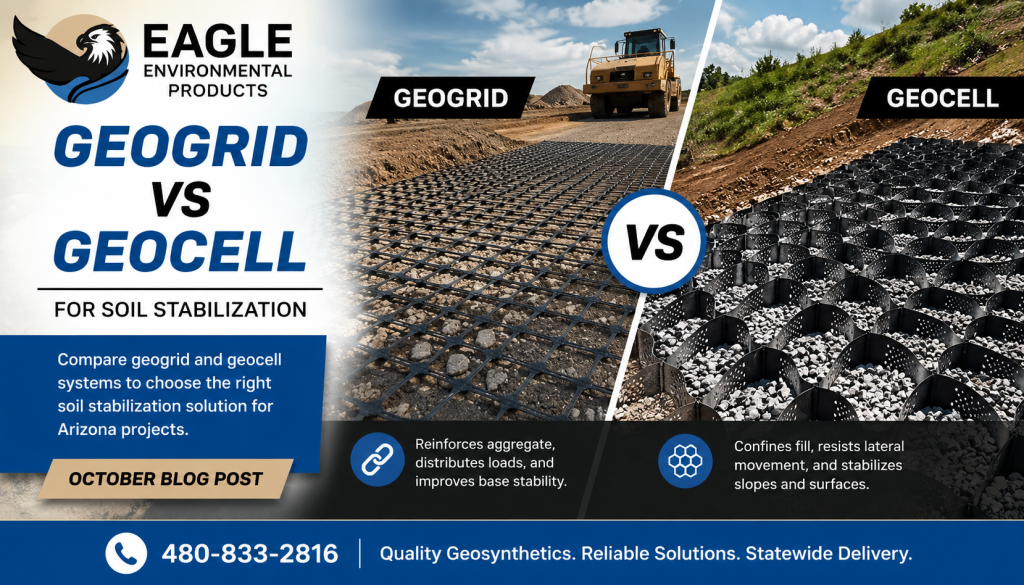
Geogrid and geocell are both used to improve weak ground, but they do not work in the same way. One is a flat grid that reinforces aggregate across a broad plane. The other forms a three dimensional cellular system that confines fill inside individual pockets. Understanding that difference is the key to choosing between geogrid and geocell for soil stabilization.
Neither product is automatically superior. The right answer depends on the surface, slope, available fill, expected traffic, drainage, and the type of movement the design must control.
How Geogrid Stabilizes A Base
Geogrid is supplied as an open grid that is rolled across a prepared subgrade. Aggregate placed above it settles into the openings. This interlock helps restrict lateral movement and spreads loading through a wider section of the base.
It is widely used beneath roads, parking lots, working platforms, haul routes, and other areas where aggregate must remain stable under repeated traffic. Certain geogrids are also designed for reinforced slopes and retaining wall systems.
Geogrid normally works best when the aggregate size and grid openings are compatible. If fine or wet soil could pump upward into the aggregate, a separate geotextile may also be required for separation. Geogrid reinforces, but it does not always perform every filtration or separation function needed on the site.
How Geocell Confines Fill
Geocell expands into a three dimensional honeycomb shaped structure. The cells are secured and filled with gravel, soil, sand, or concrete, depending on the design. Each cell limits the sideways movement of its infill, turning loose material into a more stable layer.
That confinement can be valuable on slopes, drainage channels, access roads, shoulders, embankments, and surfaces where rutting or washout is a concern. Geocell can also support vegetated systems because cells may be filled with suitable soil rather than only aggregate.
The depth of the cells matters. So do the panel material, connection method, anchoring, infill, compaction, and long term loading. A cellular system is not simply unfolded and filled without a design plan.
Choose Geogrid For Broad Base Reinforcement
Geogrid is often the practical choice when a project needs to reinforce a wide, relatively level aggregate base. It installs in flat rolls and can cover large road or parking areas efficiently. It may reduce rutting, improve load distribution, and help preserve aggregate over weak subgrade.
It is especially useful when suitable angular aggregate is available to interlock with the grid. Product selection should reflect the traffic, subgrade strength, aggregate gradation, and project specification rather than relying on a generic roll labelled for stabilization.
Choose Geocell For Stronger Confinement
Geocell deserves consideration when fill needs support in more than one direction. The cellular walls resist lateral spread throughout the depth of the panel, which can help on steep grades, around channels, or where vehicles repeatedly push loose material outward.
It may also be useful when a permeable gravel surface is desired or when locally available infill can be used within an engineered system. On slopes, the anchoring plan and resistance to runoff become just as important as load support.
Some Projects Need More Than One Product
Geogrid and geocell are not always direct substitutes. A difficult site may use geotextile for separation, geogrid for reinforcement, and geocell for surface confinement in different parts of the same design. Adding layers without a clear function, however, wastes material and can complicate installation.
Start with the failure being prevented. Is aggregate sinking into soft soil, spreading sideways under traffic, washing down a slope, or allowing fine soil to contaminate a drainage layer? The answer points toward the correct system.
Select Soil Stabilization Products With Local Support
Eagle Environmental Products supplies geogrids, geocells, geotextiles, and related erosion control materials with statewide delivery in Arizona. Call 480-833-2816 to review your application, soil conditions, loading, slope, and project documents before choosing a stabilization system.
Live References
Eagle Environmental Products: Geogrids
https://www.eagleenv.com/geogrids.htm
Eagle Environmental Products: Geocell Soil Control Solutions
https://www.eagleenv.com/geocells.htm
Tensar: Geogrid Systems And Applications
https://www.tensarinternational.com/solutions/geogrids
Colonial Construction Materials: Geocell Systems
https://colonial-materials.com/products-services/geosynthetics/geocells-geotextiles/
Presto Geosystems: Geocells And Geogrids For Road Construction
https://www.prestogeo.com/blog/why-geocells-outperform-geogrids-for-road-construction/