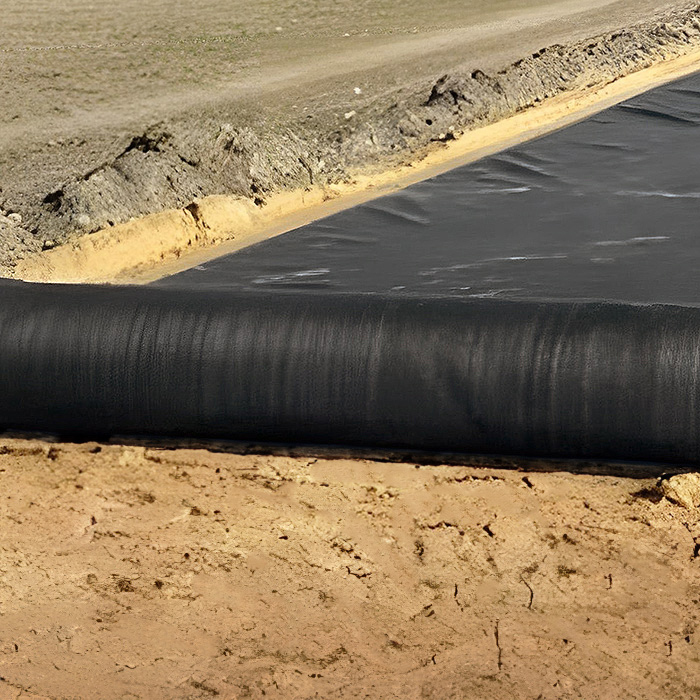
Geotextiles will be used in large civil engineering projects and even small hardscape tasks. Their main functions are to separate, reinforce, filtrate, protect, and drain.
What Are The Types Of Geotextiles?
Let’s take a look at the four main types of geotextiles used today for various projects.
Woven Geotextiles
Woven geotextile fabric is made by weaving synthetic strands together into a strong, stable sheet. It is often used where strength and separation are the priorities. Think of roads, driveways, parking areas, construction entrances, aggregate base stabilization, and areas where soft soil needs help carrying a load.
The big advantage is tensile strength. Woven fabric can help spread loads and keep aggregate from sinking into weak soil below. It is a common choice where the goal is to create a firmer working surface or add stability under rock or pavement.
Woven fabric is not always the best choice when drainage is the main concern. Some woven products allow water through, but many are selected more for strength than filtration. That is why it is important to match the fabric to the actual site problem.
Nonwoven Geotextiles
Nonwoven geotextile fabric is made with fibers bonded together into a felt like material. It is commonly used for filtration, drainage, cushioning, and protection. If water needs to pass through while soil particles stay in place, nonwoven fabric is often the better direction.
Common uses include French drains, drainage trenches, rip rap underlayment, pond liner protection, erosion control systems, and separation between soil and drainage rock. Nonwoven fabric can help keep fine soil from washing into aggregate while still allowing water to move through the system.
It can also provide puncture protection for geomembranes and pond liners. In rocky or uneven conditions, that cushioning layer can make a real difference.
Polyspun Geotextiles
These are non-woven fabrics that’s main goal is separation. Even though they are permeable and provide damage, they do not provide any extra reinforcement.
Polyspun geotextiles are most commonly utilized as weed barriers.
Spunbond Geotextiles
The spunbond process is often the quickest manufacturing method for unwoven fabrics these days. Extruded filaments will be spun onto a belt and then bonded by the application of heated rolls.
Much like polyspun geotextiles, these do not provide reinforcement. Oftentimes, these geotextiles are used as drainage fabrics or weed barriers.
Geotextile Solutions And Soil Erosion Control From Eagle Environmental AZ
Eagle Environmental Products, Inc. was formed in 1995 and has been serving the state of Arizona ever since. Our team has over 50 years of combined experience in the geosynthetic and erosion control industry. We specialize in a wide variety of geotextile products such as, woven, non-woven fabrics used in drainage, filtration, stabilization and separation.